
An Archbishop Abroad
Travelling for work in the seventh century

As an academic, even as a friend of academics, the question of how far away you are willing to move for a job comes up frequently. Factors are weighed up: the length of the journey back home, the length of the contract, the pay, what you’d teach, your colleagues, the new town or city. But what if you could never come back?
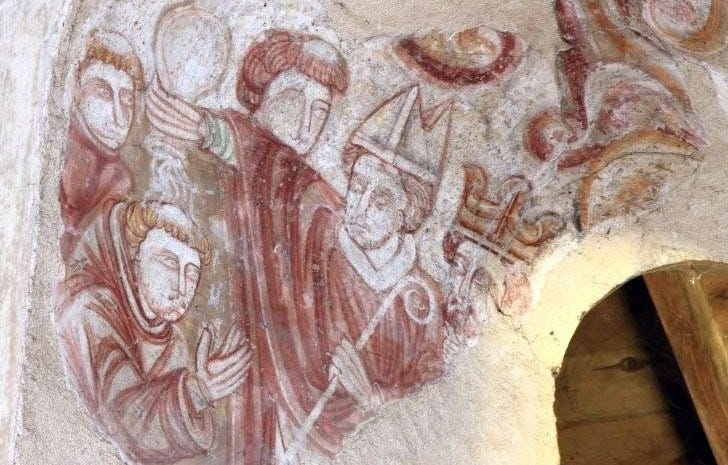
Theodore (d. 690) was born in Tarsus, in what is now Türkiye. He studied in Antioch, and then fled to Constantinople after the Persian Empire’s conquests in his homeland. At this point he was in his early to mid thirties, immersed in Greek and Syriac theology and literature. From Constantinople Theodore went to Rome, living in a monastic community who practised eastern Christianity, which was Theodore’s own tradition. Here he added Latin to his intellectual toolkit. Although Theodore’s theological training and bent was distinctly eastern, he was now conversant with the western thinkers, too. Theodore read and studied and copied texts and talked with his brothers, having found stability after leaving home as a refugee.1
But then a job came up: the man who was supposed to become the Archbishop of Canterbury (who, incidentally, bore the fantastic name of ‘Wighard’) had died suddenly. The seat was vacant. Theodore said he’d rather stay in Rome, but the Pope insisted. Theodore was consecrated in Rome and sailed to Kent, an unfamiliar kingdom in a far-flung land, as the Archbishop of Canterbury. Theodore remained in post until he died, far from home, at the age of 88.
I’ve just published an article on the Laterculus Malalianus, a strange, anonymous document that combines a Latin translation of a Greek chronicle with scriptural commentary that is decidedly Antiochene.2 It was almost certainly written by Theodore – there weren’t many Greek-speaking, eastern-style theologians knocking about in seventh-century England, where the text originated. Accepting Theodore’s authorship, then, my article analyses his reading of a poem by Proba, the Roman aristocrat whom I wrote about in ‘Rich Girls for Jesus’. It is likely that Theodore read Proba whilst he was in Rome, about three centuries after Proba had written her poem in the same city.
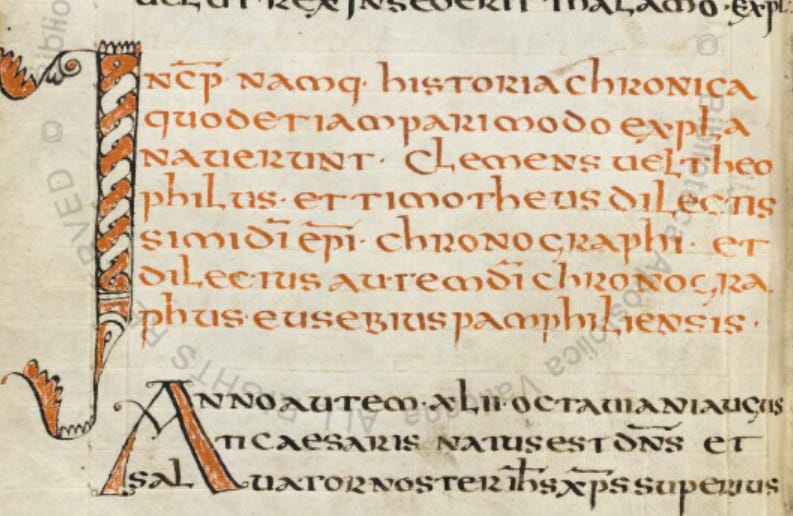
Proba composed her poem, the Cento, by chopping up and piecing together lines from Virgil. Theodore, due to his Greek education, came to Virgil much later than his counterparts in the west. In fact, the references in the Laterculus suggest that Theodore read Proba before he read Virgil – a coup for a subset of late antique Christians who recommended extreme caution when reading the pagan classics. Theodore still read Virgil, but it was through Proba’s distinctively Christian lens.
I try to avoid excessive sentimentality when looking into the past. But I hope that Theodore was happy in his new home, that he found friends among his new brothers, and that it was a joy for him to write such an odd little tract.
Much of what we know about Theodore’s early life was pieced together painstakingly by Bernhard Bischoff and Michael Lapidge. See Biblical Commentaries from the Canterbury School of Theodore and Hadrian (1994).
I’m obviously taking this opportunity to cite myself. Mary Hitchman, “The Tangled Reception of Proba and Virgil in the Laterculus Malalianus”, Journal of Latin Cosmopolitanism and European Literatures 12 (2026). doi: https://doi.org/10.21825/jolcel.95483
I loved this!
Certainly, when you're in academia you're taught to try and see everything through a more critical and detached lens. But it's such a joy to see how humans have always been human and many of the problems we have today were also there a thousand years ago.
I remember in one of my classes we were reading some literary magazines from the 1800's, and it was much fun seeing a little poem or short story of a –now– not known author, and then continue to see it in further magazine issues. Kind of like today's equivalent of eagerly following a niche writer.
Awesome post!